
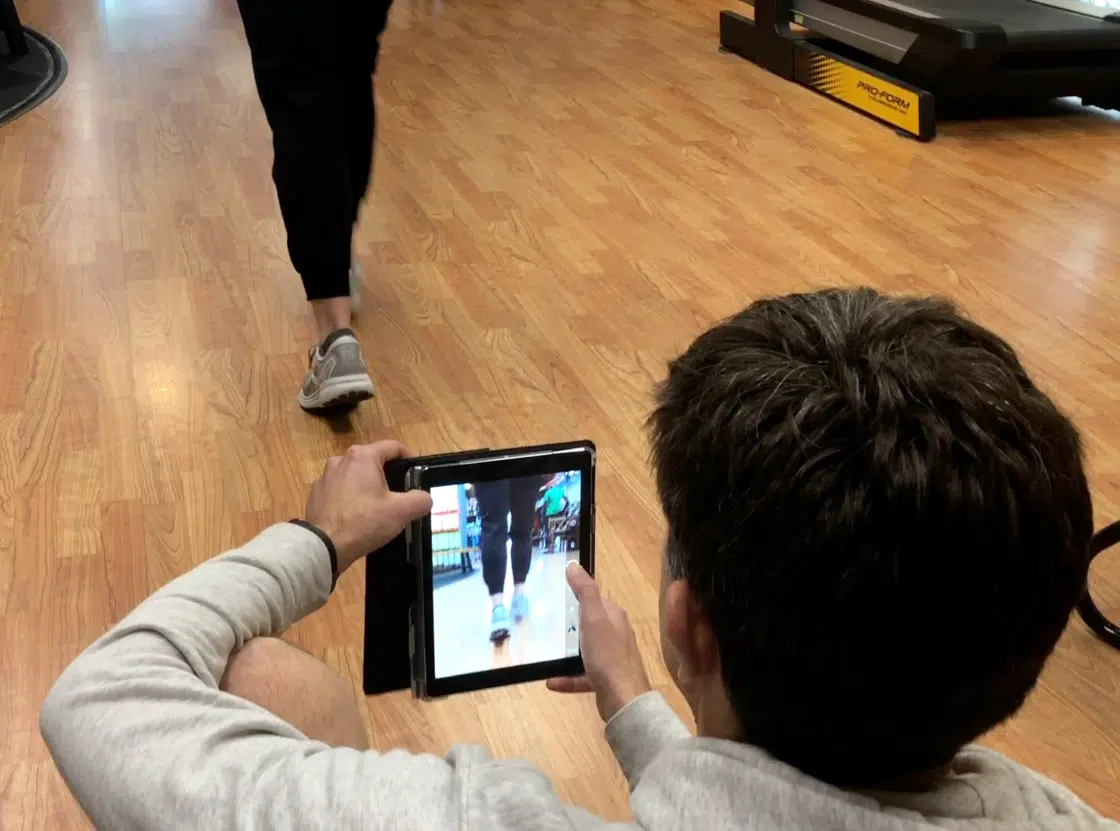
If you’ve ever watched your own stride in slow motion, you’ve had the same thought every NFL player has watching game film:
“Wait… I do that with my foot?”
Welcome to video gait analysis, the part of our fit process that blends a little science, a little art, and a surprising amount of “oh wow.” At Big Peach East Cobb, it’s also the moment when shoe fitting stops being guesswork and starts being personal. And yes: it’s one of the more useful and fun parts of what we do during the fit process.
First: What Video Gait Analysis Actually Is
Let’s keep it simple. Video gait analysis is a short clip of you walking or running that we play back frame-by-frame so we can see how your foot behaves under load, especially at midstance (that moment when your entire body weight is stacked on one leg). That one moment tells us a lot.
Standing still can be helpful, but it’s also… polite. Your weight is split between two feet. Movement is where the truth shows up. And since most people aren’t buying shoes to stand in place and stare thoughtfully into the distance (though respect if you are), watching you move is where the real insight comes from.
Why We Bother Doing It (AKA: “Because Your Feet Have a Job”)
Most people buy running shoes for… forward motion.
- Walking for exercise
- Running for training
- Moving all day at work
- Chasing a kid, a dog, or personal sanity
The more time you spend moving on your feet (and the more miles you stack) the more valuable gait analysis becomes.
Why?
Because gait analysis gives us a snapshot of how your body and foot function when the load is higher and stability matters more. A quarter-mile stroll? Your body can “get away with” a lot. A 10K, half marathon, marathon, or “I’m on my feet for 10 hours” job? Small things add up fast. So we do gait analysis to help answer a practical question: Do you look relatively stable under load… or are you working harder than you need to?
How We Do It at Big Peach East Cobb
Our process is intentionally simple:
- We put you in a known neutral baseline shoe (not designed to offer “asymmetrical support” or support that is more prominent on the inside (medial) part of the shoe.
- We capture a quick video of you walking or running.
- We watch it back in slow motion / frame-by-frame and talk through what we see.
The goal isn’t to label you with some permanent identity (“You are an Over-Pronator”) or send you into the world with a medical diagnosis. The goal is to gather one more useful data point: What does your foot do when your body asks it to absorb force, stabilize, and move you forward? And we explain what we’re seeing in real time—because it’s your stride, not a magic trick.
The Part Nobody Tells You: Gait Analysis Has Limits (And That’s Okay)
This is important. A retail gait analysis is a tiny snapshot, not a documentary series. If you’re running, fatigue causes your form to change over time. What you do at second 8 might not be exactly what you do at minute 18. Even major footwear research teams have seen trends where mechanics can drift (often toward more collapse/overpronation) as you continue running. So we treat gait analysis like what it is: A very useful clue—not the whole case file.
That’s why we combine it with the other parts of our fit process:
- Your goals (running, walking, moving all day).
- Your footwear history (what worked, what didn’t).
- Any aches/pains/injuries you’re managing.
- Your foot characteristics (shape, width, volume, arch) via scan.
- And, finally… the detail that matters most: how the shoe feels on your foot.
How Gait Analysis Influences Shoe Selection (Without Overpromising)
Here’s the honest way to say it: If your foot looks less stable under load, you might benefit from:
- A more supportive platform (sometimes referred to as a “stability shoe”)
- Or sometimes an over-the-counter insert (depending on the situation)
But it’s not automatic. It’s not “unstable stride = must wear stability forever.” It’s more like:
“Let’s test whether a little more support makes you move and feel better.”
Because comfort counts. Fit counts. Ride counts. And those can outweigh a theoretical “perfect” stability choice. Also worth noting: the line between “neutral” and “stable” running and walking shoes isn’t as dramatic as it once was. Sometimes the biggest difference is feel—slightly firmer here, slightly softer there—with many options providing excellent support.
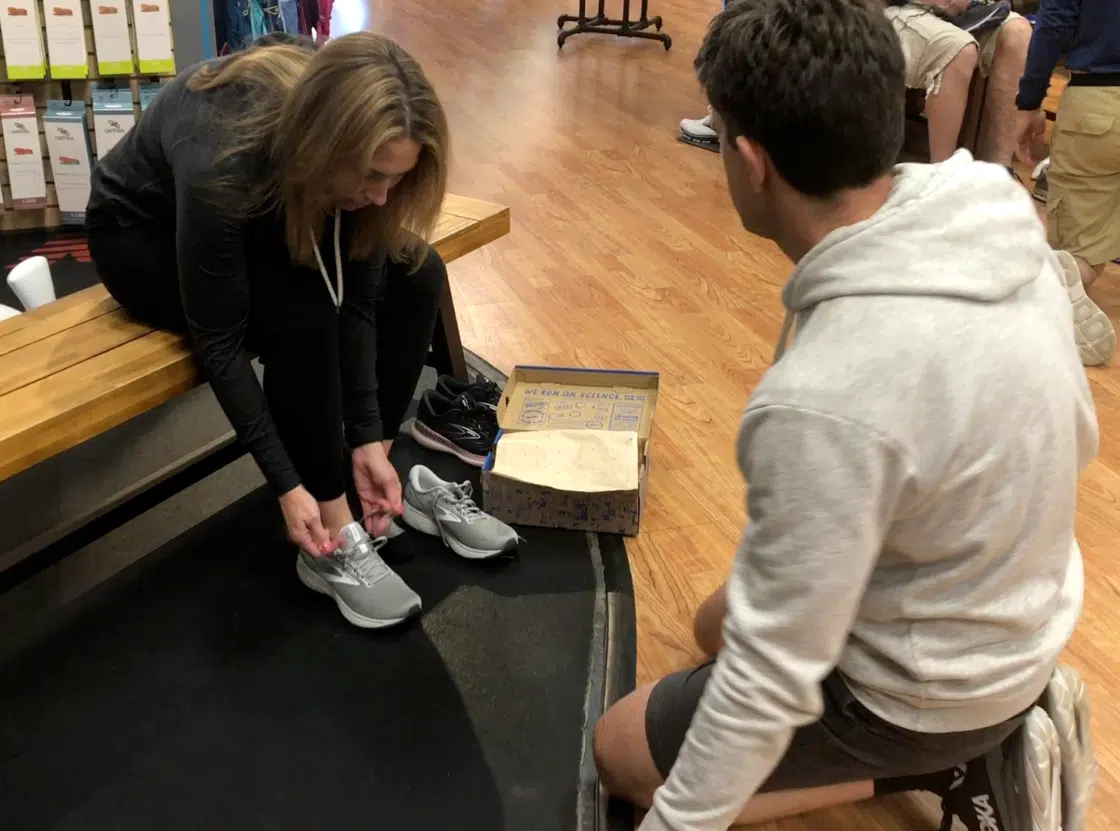
The “Art” Part: Fit, Feel, and the Joy of Two Shoes at Once
If you’ve done our fit process, you’ve probably experienced the moment where we hand you two different shoes and say: “Yep. One on each foot. Go walk.” It’s fun, and it’s also incredibly effective.
Because gait analysis helps us understand mechanics, but your nervous system helps us understand preference. Some people want a soft, floaty ride. Others want a more connected, responsive feel. And your body is usually very honest about what it likes once you can compare. That’s why the final step of our fit process is “Shoes on Feet!”—trying options, comparing them, and letting your foot “vote.”
Where This Fits Into Our Full Fit Process
At Big Peach, our fit process is:
- Learn about you (goals, history, any discomfort)
- Foot scan (2D/3D data on shape + pressure)
- Video analysis (quick clip, frame-by-frame breakdown)
- Shoes on feet (try, compare, dial in fit + feel)
It’s free, and you don’t need an appointment. And if you watch our fit-process video, you’ll see that same flow in action—simple, fast, and surprisingly fun.
Bottom Line
Video gait analysis won’t “solve your waling or running” in 10 seconds. But it will help us make smarter choices, faster, and it turns shoe fitting into a collaborative experiment instead of a sales pitch. If you’re in the East Cobb area and want a fit that’s equal parts science and common sense, come see us!
FAQs: Video Gait Analysis at Big Peach East Cobb
Yes—our fit process (including video analysis) is free.
No appointment needed. Just walk in.
Both. The more time you spend moving (walking for fitness, running, standing all day), the more useful it tends to be.
It helps us see how your foot behaves under load (especially at midstance, when one foot is in full contact with the ground) so we can make better decisions about what level of support might help.
Not necessarily. If you look less stable, we may test more supportive options, but comfort, fit, and feel still win.
The evaluation portion is quick (about five minutes), and then we spend the time needed trying shoes so you can compare fit and feel.
Yes, especially if they’ve been great (or terrible). Wear patterns and history are helpful.
No. It’s a footwear tool, not a medical exam. If pain is persistent, we’ll encourage appropriate clinical support.